In short
- The green flash identifies a vehicle that cannot produce any tailpipe emissions under the applicable number-plate regulations.
- It is optional and sits on the left-hand side of an otherwise compliant front or rear number plate.
- Battery-electric and qualifying fuel-cell vehicles fit the zero-tailpipe definition, while combustion-engine hybrids do not.
- A green flash is not a green P plate, a clean-air-zone pass, a tax class or proof of eligibility for every local incentive.
The important word is not electric. It is tailpipe. The green flash belongs to a vehicle that cannot produce tailpipe emissions. That includes battery-electric and qualifying fuel-cell vehicles, but it excludes a hybrid whose combustion engine can still emit from an exhaust.
What does the green stripe on a UK number plate mean?
The green stripe is officially a green flash identifying a zero-tailpipe-emission vehicle. The 2020 regulations define an eligible vehicle as one that cannot produce any tailpipe emissions. Display is optional, not compulsory.
The current GOV.UK plate rules say a zero-emission vehicle can display a green flash. The underlying 2020 amendment is more precise: the vehicle must be unable to produce tailpipe emissions.
That wording prevents the marking becoming a general badge for vehicles described as electrified, low emission or plug-in. It identifies one legal category for plate display rather than awarding an environmental score.
The government introduced the design on 8 December 2020. Existing eligible vehicles can be fitted with compliant replacement plates carrying the flash; it was not limited to vehicles first registered after the launch date.
Where does the green flash appear?
The green flash appears on the left-hand side of the number plate as a vertical green area. It can be used on front and rear plates and can appear with permitted national flags and identifiers. The registration characters and complete plate rules remain unchanged.
The Department for Transport selected a left-side flash rather than green registration characters, a border or an EV prefix. Its consultation response explains that extra lettering could interfere with automatic number-plate recognition and that a flash was clearer.
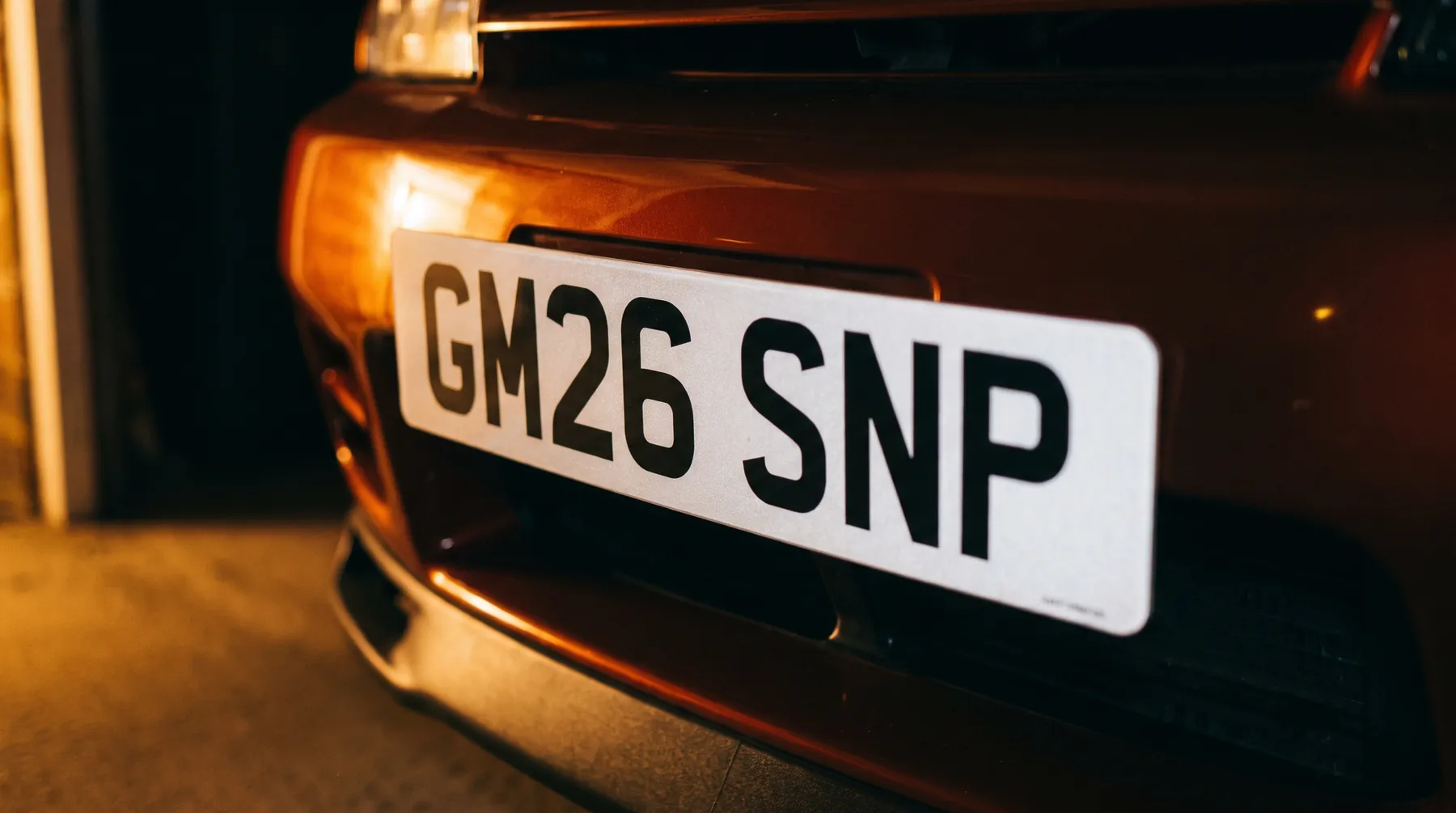
The ordinary front plate remains black characters on a white reflective background, while the rear remains black on yellow. The flash does not allow a green background pattern, coloured characters or reduced spacing.
A trailer towed by an eligible vehicle can also fall within the regulation's optional arrangement. That specific case should be handled by a registered supplier using the current rules rather than copied from a road photograph.
The phrase "green number plate" can mislead because the complete plate is not green. Only the left-side identifying area is.
Which vehicles are eligible for the green number-plate flash?
An eligible vehicle is one that cannot produce tailpipe emissions. Current government vehicle definitions identify battery-electric and fuel-cell-electric vehicles as zero-emission categories. Eligibility follows capability at the tailpipe, not fuel marketing or charging method.
| Vehicle type | Can it produce tailpipe emissions? | Green flash |
|---|---|---|
| Battery electric | No tailpipe | Eligible |
| Fuel-cell electric | No CO2 tailpipe emissions in the official ZEV class | Eligible when it meets the legal definition |
| Plug-in hybrid | Yes, from its combustion engine | Not eligible |
| Mild or self-charging hybrid | Yes, from its combustion engine | Not eligible |
| Petrol or diesel only | Yes | Not eligible |
The current DfT licensing definitions place battery-electric and fuel-cell-electric vehicles in the zero-emission group. Plug-in hybrids are listed separately because they can use both electricity and fuel.
A conversion needs documentary and registration checks. Removing an exhaust or claiming an electric conversion does not by itself establish the official vehicle record, construction standard or plate eligibility. Ask DVLA and a registered supplier when the car's powertrain has materially changed.
Why can a plug-in hybrid not use the green flash?
A plug-in hybrid has a combustion engine capable of producing tailpipe emissions. The legal test is whether the vehicle can produce any tailpipe emissions, not whether a particular journey happened in electric mode or whether official CO2 is low.
Plug-in hybrid, self-charging hybrid and mild hybrid describe different electrical assistance and charging arrangements. All retain a fuel-burning engine in the usual designs, so they fail the zero-tailpipe test.
An advert may call a plug-in hybrid "zero emission in EV mode". That can describe one operating mode but not the vehicle's complete capability. Plate eligibility applies to the vehicle, not the driver's intention to avoid starting the engine.
Tax, grants and clean-air-zone schemes can define classes for their own purposes. A nominal CO2 figure in another policy does not rewrite the number-plate regulation. Keep each scheme's test separate.
Is the green number-plate flash compulsory?
No. An eligible zero-tailpipe-emission vehicle may display the green flash but does not have to. Its registration number stays the same, and a normal compliant plate remains valid when the optional identifier is absent.
The flash does not create a new age code, local memory tag or random letter group. The number-plate year chart continues to decode the same registration characters.
Retrofitting means buying compliant replacement plates, not adding tape, vinyl or paint to an existing plate. Material, reflectivity, supplier mark and British Standard still apply, so altering the old plate by hand risks making it non-compliant.
A vehicle can change keeper or registration while remaining eligible. The green flash describes the vehicle's tailpipe capability, while assignment and entitlement rules control the registration itself.
Can a green flash appear with a UK flag or identifier?
Yes. The government introduced the flash so it can be displayed with permitted national flags and identifying letters. The flag and identifier must still use an approved combination and layout, and international UK-sticker rules remain a separate question.
The legal flag and identifier guide lists Union, English, Scottish and Welsh options and explains the current travel rules. A green flash does not turn a custom club badge into a permitted national emblem.
For travel outside the UK, what appears in the national identifier area decides whether a separate UK sticker is needed. Spain, Cyprus and Malta require the sticker regardless. Recheck current GOV.UK guidance before travelling.
Do not compress the registration mark to make space for both features. A registered supplier should apply the approved layout while preserving margins, character size and spacing.
Does a green flash guarantee free parking or clean-air-zone access?
No. The flash identifies the vehicle category but does not itself guarantee a local benefit. Parking, charging bays, road-user charges and clean-air zones each have their own current eligibility, registration and payment rules.
The original government announcement said the identifier could support local incentives. "Could" is not a nationwide entitlement. A council or operator can require registration, impose time limits, restrict a bay to active charging or change a scheme.
Use the official GOV.UK clean-air-zone service for participating English zones and follow its links for London and Scotland. Check the relevant council or operator for parking and charging-bay rules.
A plate colour is visible evidence, not the database decision. Cameras and enforcement systems read the registration and compare it with records. Never assume the flash overrides a charge shown by the official checker.
How do you get a compliant green-flash number plate?
Use a number plate supplier registered with DVLA and bring original identity and entitlement documents. Ask for a plate meeting the applicable British Standard and current green-flash layout. Do not buy a decorative show plate for road use.
The current GOV.UK supplier page lists documents that prove identity and the right to use the registration. These can include the V5C, green new-keeper slip, V750, V778 or an authorised certificate depending on the situation.
General rules still require reflective material, correct black characters, white front and yellow rear backgrounds, supplier marking, British Standard and no background pattern. Plates fitted after 1 September 2021 use BS AU 145e and single-shade black characters.
Incorrect display can lead to an MOT failure and a fine of up to £1,000 according to GOV.UK. The optional flash is not worth compromising the complete plate.
What does a green flash mean on personalised car artwork?
On artwork, a green flash can reproduce a visible feature of an eligible car, but it does not certify or manufacture a legal road plate. The standard builder personalises the registration and uses a clean front-plate treatment; specialist plate details need clear reference photographs.
A poster plate does not include reflective material, supplier marks or a British Standard. It is an illustration. Keep that distinction clear when previewing a registration online.
If the recipient's eligible car visibly uses the flash and that detail matters, send a square front photograph through the custom request route. Do not add it to a hybrid print merely because the green colour suits the background.
Preview a registration on a current car print. Use a registered supplier for the road plate itself.
Which sources support this green-flash guide, and when was it checked?
This guide was checked on 9 August 2026 against current GOV.UK number-plate rules, the Road Vehicles display amendment, DfT's green-plate announcement and current vehicle-class definitions.
Primary references are SI 2020/1276, GOV.UK plate rules, and the Department for Transport introduction.
Rules and local incentives can change. Recheck the official page when ordering a physical plate and the relevant local service before parking or entering a charging or clean-air zone.
Questions people actually ask
- What does the green stripe on a UK number plate mean?
- It identifies an eligible zero-tailpipe-emission vehicle. The legal wording covers a vehicle that cannot produce any tailpipe emissions. The green flash is optional and sits on the left side of the number plate.
- Can a hybrid car have a green number plate flash?
- Not when its combustion engine can produce tailpipe emissions. This excludes ordinary, mild and plug-in hybrids from the zero-tailpipe definition even if the vehicle can travel some distance using electric power.
- Do all electric cars need a green stripe on the number plate?
- No. The green flash is optional. An eligible battery-electric or fuel-cell vehicle can display a normal compliant plate without it. The registration mark and all general plate rules remain the same.
- Is a green number plate the same as a green P plate?
- No. A green P plate is an optional probationary sign used by a newly qualified driver in Great Britain. The green number-plate flash identifies an eligible zero-tailpipe-emission vehicle, regardless of driver experience.
Written by Jonathan in Derby. Last updated .