In short
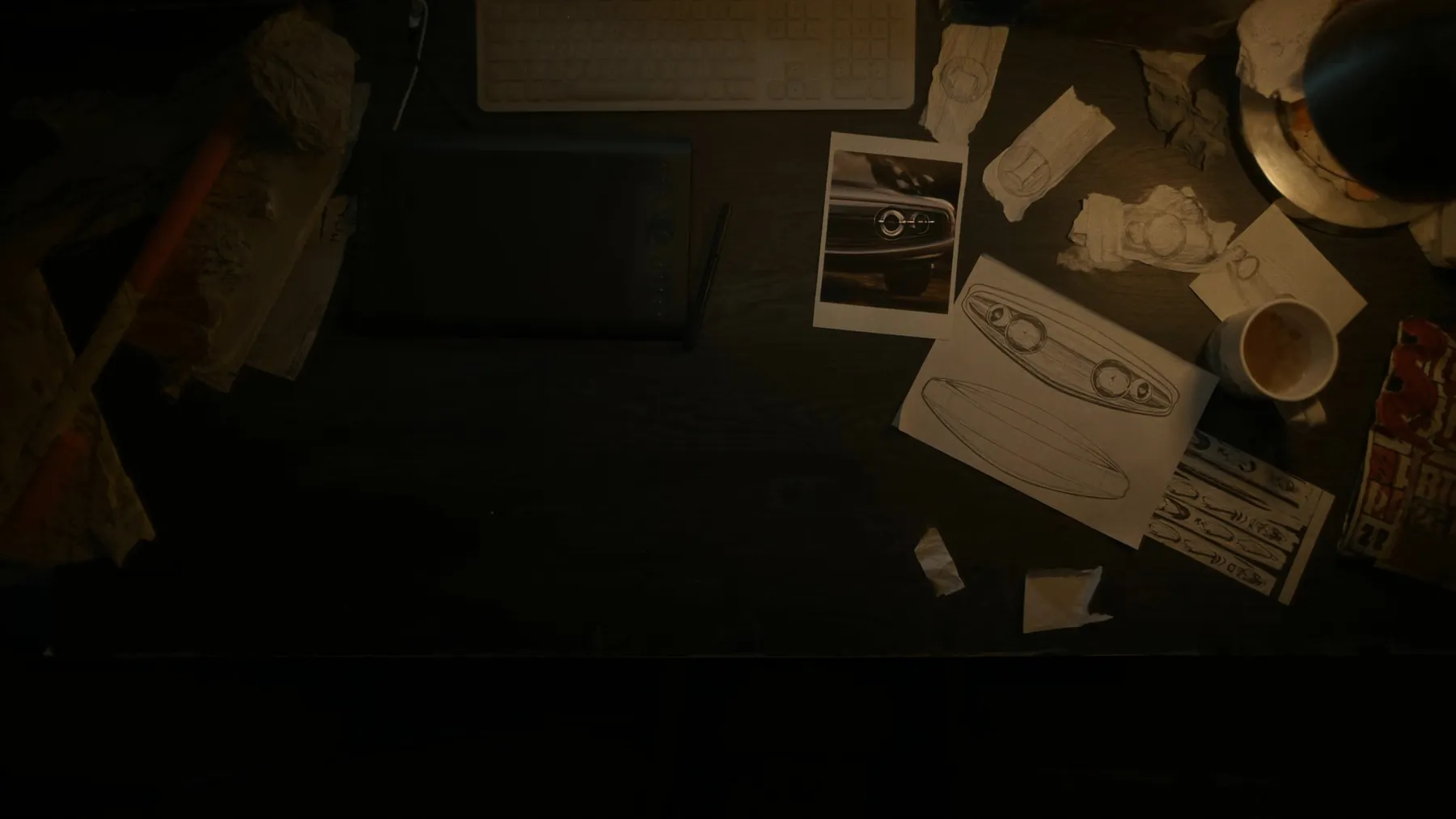
- Each car is drawn by hand in Photoshop as separate panels, details, and shading layers.
- Keeping the shading separate lets the builder change paint without flattening the drawing.
- Poster figures are checked before a model is allowed into the catalogue.
The first car I ever charged for took nineteen hours. It taught me exactly where the hours go, and they do not go where people assume.
Why not just run a filter over a photograph?
Because a filter flattens the thing you were trying to keep. It takes the way light sits along a shoulder line and turns it into a band of colour. The car stops being that car and becomes a shape that is roughly the right colour.
A filter has to interpret the details it cannot see. That is where headlight internals, badges, panel gaps and shaded wheel arches lose the shapes an owner recognises.
A photograph records one afternoon. It has whatever weather was happening, whatever was parked behind, and a wheel arch in shadow because the sun was where it was. A drawing can show the car the way its owner pictures it, which is never a specific Tuesday in a Tesco car park.
What actually gets drawn
The body goes down as separate panels. Bonnet, wing, bumper, arch, sill. Not because it looks better in the file, but because a real car is made of separate panels and light lands on each of them differently.
Then the shadows are drawn as their own layers, in their own relationship to the base colour, rather than being painted on top in a fixed grey. That decision is the one everything else depends on.
Have a go at breaking it. The slider below flattens the shading towards nothing, which is roughly what a colour swap on a photograph does.
Where the hours actually go
Not the body. The body is the satisfying part and it goes quickly once the proportions are right.
The slow parts are the headlights, the badge and the plate. Headlights because they are glass over reflectors over a bulb, and if you draw them as one shape the car looks asleep. Badges because everybody knows what their own badge looks like at a glance. The plate because it is small, legally spaced, and sitting on a bumper that curves away from you.
- Drawing
- about 19 hours
- Panels
- drawn separately
- Shading
- its own layers
- Figures
- checked twice
- Photo filter
- not used
The numbers on the poster
Every print carries the engine, the power, the torque, the weight and the sprint time. Those get checked against a second source before a model goes on sale, and a model does not go on sale until they have been.
This sounds like overcaution for a poster. It is not. Someone who owns the car will know the figure, and a wrong number on something they were going to hang on a wall is a refund and a bad review, in that order. If I cannot confirm a figure, the poster does not carry it.
What happens after it is drawn
It goes into the shop as a model anybody can build. You pick the paint, type your registration, choose a size, and the artwork on your screen is the artwork that goes to print. There is no proof cycle because there is nothing left to approve.
Choose a catalogue car, or use the photo guide before you send me photographs of yours. The most-requested cars get drawn next, which is the closest thing I have to a plan.
Questions people actually ask
- Are the car prints drawn by hand?
- Yes. Each car is drawn by hand in Photoshop, one panel at a time, rather than made by running a filter over a photograph. The builder changes the paint colour and registration on that finished drawing.
- Why does the shading stay right when the colour changes?
- Because the shading was drawn as its own layer rather than painted into the car. Each shadow keeps a relationship to the base colour instead of a fixed value, so a white car still reads as white rather than turning into a flat cut-out.
- How long does one car take to draw?
- About nineteen hours for the first one of a model. The panels, the light and the badges all get drawn separately, and the specification figures are checked against a second source before the model goes on sale.
Written by Jonathan in Derby. Last updated .