In short
- Measure the available wall area after accounting for furniture, switches and anything already hanging nearby.
- Mark the exact print dimensions with removable tape or a paper template, then view them from normal positions in the room.
- The catalogue offers A4, A3, A2 and 60 x 90 cm unframed print sizes. Framed products have their own listed dimensions.
A size menu asks you to imagine a rectangle while looking at a phone. Move the decision to the wall. A measuring tape, four small marks and the view from the doorway answer it with fewer assumptions.
Which car print size should you choose?
Choose the size that fits the clear wall area and reads properly from the places where the room is used. Test its exact dimensions on the wall. Do not choose from A-series names or a close-up product image alone.
First define the available area. Furniture, light switches, shelving and nearby pictures are the boundaries. The whole wall measurement is usually less useful than the empty rectangle left between them.
How large are A4, A3, A2 and 60 x 90 cm prints?
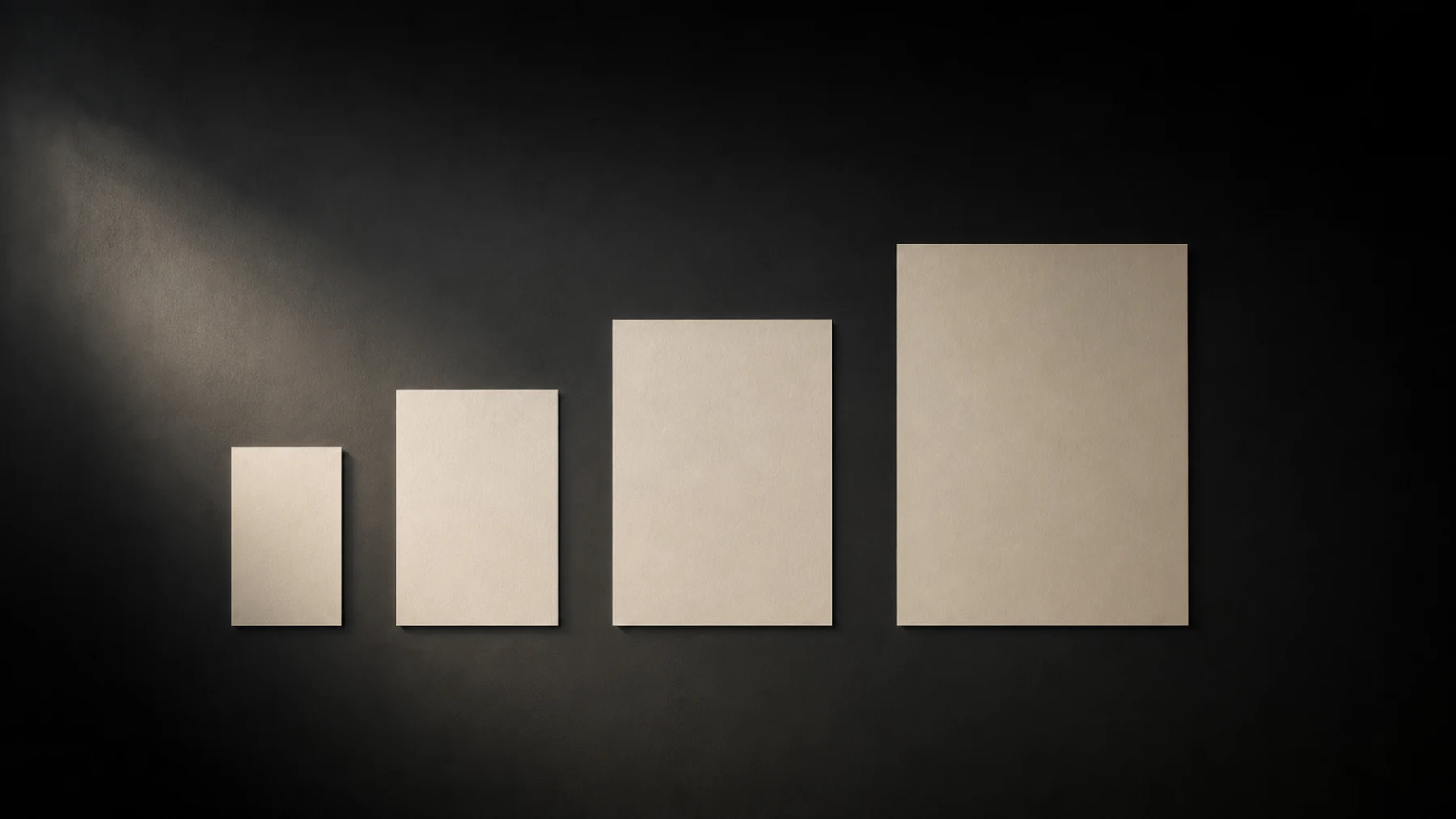
The catalogue print sizes run from 21 x 29.7 cm at A4 to 60 x 90 cm. Use the interactive comparison for relative scale, then make a full-size template for the final check.
| Catalogue size | Dimensions |
|---|---|
| A4 | 21 x 29.7 cm |
| A3 | 29.7 x 42 cm |
| A2 | 42 x 59.4 cm |
| 60X90 | 60 x 90 cm |
How should you test a print size on the wall?
Mark the four corners at the exact width and height, then step back to normal viewing positions. Test the room in daylight and its usual evening light because the surrounding wall can read differently even though the dimensions do not change.
Removable tape can mark the corners. A sheet made from spare paper makes the rectangle more obvious. Check the product orientation before measuring, and use fixing methods suited to the wall and the final product.
What changes when you choose a digital file?
A digital file changes who handles the physical output, not the need to choose an intended size. The catalogue labels one file for A3 at 300 DPI and a separate full-resolution option. Follow the chosen product specification rather than assuming every file is interchangeable.
This article cannot make claims about a printer, paper or frame that you choose elsewhere. Share the file’s stated format with the supplier and ask them to confirm what they will produce.
What does this print size guide not claim?
This guide compares catalogue dimensions only. It does not claim first-hand experience of this site’s paper, frames, print quality or colour reproduction, and it does not infer an external frame size from an unframed print.
Product choices and dimensions come directly from the shop’s pricing catalogue. To see how the artwork itself is assembled, read how a car print is drawn. To decide which reference images are useful for a car that is not listed, use the car photography guide.
Questions people actually ask
- What size car print should I choose?
- Choose by testing the actual dimensions on the intended wall. Measure the clear area, mark the print corners with removable tape or a paper template, and view the rectangle from the doorway and usual seat. A room photograph alone can distort scale.
- What are the dimensions of A4, A3 and A2 car prints?
- The catalogue lists A4 as 21 x 29.7 cm, A3 as 29.7 x 42 cm and A2 as 42 x 59.4 cm. It also offers a 60 x 90 cm print. These are print dimensions, not a promise about an external frame size.
- Is A3 twice the size of A4?
- A3 has twice the area of A4, but its width and height are not doubled. In portrait orientation A4 is 21 x 29.7 cm and A3 is 29.7 x 42 cm. Marking both rectangles is clearer than judging the names.
- Does this size guide include frames?
- The visualiser compares the unframed print dimensions listed in the catalogue. Framed products have their own product dimensions, and the space a frame occupies should be checked from that listing rather than inferred from the print size.
Written by Jonathan in Derby. Last updated .