In short
- Great Britain has used six main registration formats since compulsory registration began.
- Suffix plates put the year at the end, prefix plates put it first, and current plates put it in the middle.
- Northern Irish registrations remain dateless and use combinations containing I or Z.
I draw registrations for a living, which means I have to know what a plate from any given year is supposed to look like. A suffix character in the wrong place changes the date the registration communicates, so the format has to be established before the plate is drawn.
How many number plate formats has Britain used?
Six main formats in Great Britain, with a separate dateless system in Northern Ireland. The first three GB formats carry no date. The last three do, and the date sits at the end from 1963, at the front from 1983 and in the middle from 2001.
Every one of them is below, drawn rather than photographed. The plates in the panel come out of the same code that sets the registration on the prints I sell, in the same typeface, so you are looking at the real letterforms and not a screenshot of somebody else’s car.
Current-format definitions, memory tags and age identifiers come from the official DVLA INF104 leaflet. Display rules, including reflective grounds and traditional plates, come from GOV.UK.
| Format | Issued | Example | Where the date is |
|---|---|---|---|
| One or two letters | 1904 to 1932 | A 1 | Nowhere |
| Three letters | 1932 to 1953 | ABC 123 | Nowhere |
| Reversed | 1953 to 1963 | 123 ABC | Nowhere |
| Suffix | 1963 to 1983 | ABC 123A | Last character |
| Prefix | 1983 to 2001 | A123 BCD | First character |
| Current | Sept 2001 onward | GM26 SNP | Middle two digits |
| Northern Ireland | 1903 onward | AAZ 1234 | Nowhere |
1904 to 1963: the years with no date in them
Registration became compulsory under the Motor Car Act 1903 and the first marks went out from 1 January 1904. A code for the council that issued it, then a number. A 1 belonged to London County Council, and it is the reason dateless plates are collected at all.
The format then ran out of room twice. A third letter was added in July 1932, which bought twenty years. When the busier councils exhausted that too, in 1953, the answer was to turn it around and put the numbers first. Same characters, opposite order.
None of the three says anything about age, and that is exactly why they are still valuable. A plate that cannot make a car look newer than it is may legally go on a vehicle of any age, which is the one thing no dated plate can do.
1963: the year letter arrives, on the end
A single letter was added to the end of the registration, and it told you the year. A is 1963, B is 1964, C is 1965, and so on to Y in 1982. This is the first format that dates a car at a glance.
The detail almost everybody gets wrong is when the letter changed. For the first four years it changed on 1 January, like a calendar. Then the motor trade pointed out that this put every registration in the country into the same fortnight, so the changeover was moved to 1 August. E is the casualty of that decision: it ran from January to July 1967 and nothing else.
- I
- reads as 1
- O
- reads as 0
- Q
- reads as O
- U
- reads as V
- Z
- kept for Ireland
1983: the letter moves to the front
From 1 August 1983 the year letter swapped ends. A123 BCD, where the A is the year. This is the era most people can still read without thinking, because it is where the R reg and the W reg live.
It changed every August until 1999, when the pressure that had moved the date in 1967 finally split it in two. From then on there were two changes a year, on 1 March and 1 September, which is why the last six letters of the scheme each cover half a year rather than a whole one.
| Letter | First registered |
|---|---|
| S | August 1998 to February 1999 |
| T | March 1999 to August 1999 |
| V | September 1999 to February 2000 |
| W | March 2000 to August 2000 |
| X | September 2000 to February 2001 |
| Y | March 2001 to August 2001 |
Y was the final prefix identifier. The current format replaced the scheme in September 2001.
2001: the one on almost every car
The current format arrived on 1 September 2001 and it is the one covered in detail in what your number plate actually says, along with a decoder that will read yours back to you. The short version: two letters for the memory-tag region, two numbers for the date, then three random letters.
It was designed with fifty years in it. The March plate carries the year and the September plate carries the year plus fifty, which works cleanly until February 2051.
If the registration is going onto a different car, check the separate guide to whether a private plate is old enough for it.
Northern Ireland uses a separate dateless system
The six-step GB sequence above does not apply to Northern Irish registrations. The familiar current pattern uses letters containing I or Z followed by up to four numbers, and it carries no age identifier.
That is not a coincidence. I and Z were set aside for Irish registrations right at the start, which is why they are the letters missing from every scheme used on the mainland. The system remains dateless, so a Northern Irish registration does not establish the age of the vehicle wearing it.
The Northern Ireland plate guide goes further into the letter pattern, QNI registrations, transfers and the checks to make before using one on a print.
Who can still run a black and silver plate
Vehicles built before 1 January 1980, registered in the historic vehicle tax class. That date is fixed. The exemption used to roll forward on a forty year cycle, so it stopped moving, and a car built in 1981 will not become eligible by waiting.
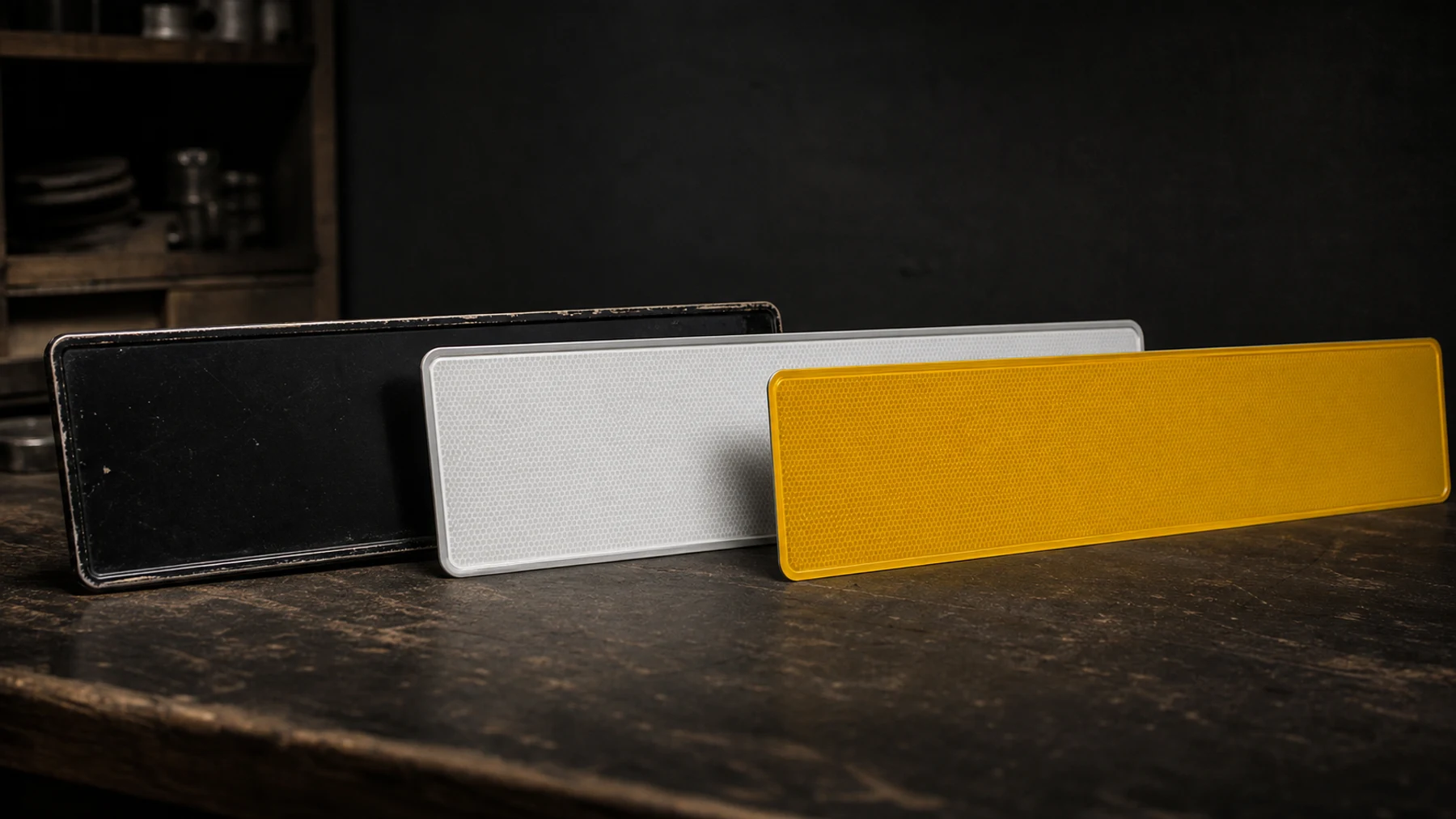
Reflective plates, white at the front and yellow at the back, became the requirement for vehicles registered from 1 January 1973. Everything before that wore silver or white characters on black, which is why the older formats in the panel above are drawn dark.
It matters to me more than it sounds like it should. Drawing a 1965 car with a modern white plate on it is the same class of error as putting the wrong badge on the grille, and it is the first thing an owner would notice.
Why I had to learn all this
Because the plate is the part of the drawing that makes it somebody’s car rather than a car. It is three centimetres wide on an A4 print and it takes longer to get right than the wheels do: correct typeface, legal spacing, correct ground for the year, sitting at the angle the bumper actually sits at.
If your car is old enough to wear black and silver, that is drawn properly too rather than approximated with a grey rectangle. The builder is here if you want to see yours, and if the car itself is not in the catalogue yet then I will draw it.
Questions people actually ask
- How many number plate formats has the UK used?
- Six in Great Britain since registration began in 1904: the original one or two letter marks, three letter marks from 1932, the reversed version from 1953, suffix from 1963, prefix from 1983, and the current format from September 2001. Northern Ireland has used its own dateless system throughout.
- When did UK number plates change to the current format?
- On 1 September 2001. It uses a two-letter DVLA memory tag, two numbers for the issue period and three random letters. It replaced the prefix scheme and its published identifiers run through February 2051.
- Can I put a black and silver number plate on my car?
- Only if the vehicle was built before 1 January 1980 and is registered in the historic vehicle tax class. The old rolling exemption was stopped, so the cut-off no longer moves forward each year, and a 1981 car cannot legally wear one.
- Why do Northern Ireland plates have an I or a Z in them?
- Those two letters were set aside for Irish registrations when the system began, which is why they are missing from the schemes used in Great Britain. Northern Ireland plates are also dateless, so they say nothing about how old the car is.
Written by Jonathan in Derby. Last updated .